University of St. Thomas Athletics
Throwback Thursday: 1918 quarantine let Toms host Gophers
5/6/2020 12:00:00 AM | Football
The devastating global Spanish Flu pandemic of 1918 is considered one of deadliest disease outbreaks in recorded history. An estimated 500 million people -- one-third of the world's population -- became infected with this virus, and the number of deaths was estimated to be at least 50 million worldwide, with about 675,000 occurring in the United States.
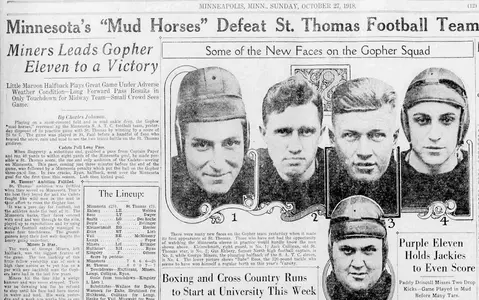
The outbreak created a quarantine of large gatherings in the city of Minneapolis but less restrictions in the city of St. Paul. That prompted a scheduled football game between the Minnesota Gophers and St. Thomas set for Oct. 26, 1918 to be moved from the Gophers' campus across the river to St. Thomas.
Minnesota won 25-7 in a game played in a snowstorm. The wet, cold weather diminished what was expected to be a large crowd.
One of the Gophers' touchdowns was scored by star halfback Jack Culligan, a former St. Thomas player. The Toms scored a late touchdown to avoid a shutout and and game some level of respect.
Minnesota was coached by Henry L. Williams, whose teams won eight Big Ten championships from 1900-1915. St. Thomas first-year coach Henry Hanson was an All-Big Ten back for the Gophers under Williams in 1916 and was an assistant coach there in 2017.
Both schools were shorthanded that fall with many top student-athletes serving in the military during the late stage of World War I.
Several accounts of the game are posted below:
--
University library archivist Ann Kenne wrote this story with more details on the flu's effects on campus:
Tales from the Archives — The 1918 Spanish Influenza Epidemic at St. Thomas
By ANN KENNE/ Head of Special Collections, University Archivist
"Have you gotten your flu shot yet?" has been a common refrain as people have struggled with this year's flu season. All of this talk about the flu outbreak brings back memories of the 1918 Spanish Influenza Epidemic.
The first diagnosed case of Spanish Influenza appeared in Minnesota in late September 1918. Classes had already started for the college and high school students enrolled at St. Thomas. A unit of the Student Army Training Corps (SATC) – a contingent of soldiers preparing to fight in World War I – were also posted on campus.
Unlike our neighbors in Minneapolis, St. Paul did not immediately close schools and public gathering places when the epidemic became widespread. Instead, authorities recommended that people with flu isolate themselves to prevent the spread of the illness. One consequence of the closure of "places of amusement" in Minneapolis was the relocation of the October 26 football game between St. Thomas and the University of Minnesota's SATC unit to the College of St. Thomas campus.
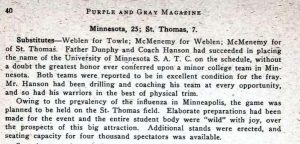
Purple and Gray, December 1918, p. 40
Students who contracted the flu and lived on campus were nursed in the College Infirmary ; commuter students were cared for at home.
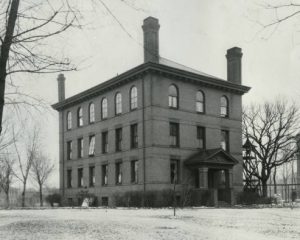
College of St. Thomas Infirmary, 1920
While no records exist which tell us how many of the approximately 1200 students at the College contracted the Spanish influenza during this outbreak, at least three St. Thomas students and one member of the SATC corps died from the flu.
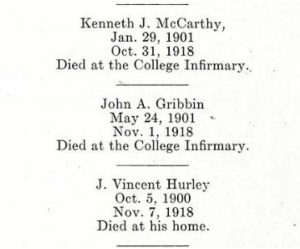
Alumni Bulletin, February 1919, p. 13
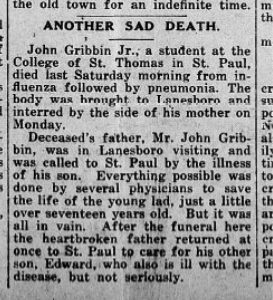
Levang's Weekly, November 7, 1918 p. 1
The influenza outbreak reappeared in the winter of 1919 – 1920 claiming at least one student at the College. This second outbreak hit the Saint Paul Seminary particularly hard, claiming the life of one seminarian and laying a number of them low.
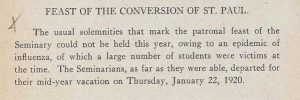
St. Paul Seminary Register, 1920
--
Here are selected newspaper and yearbook clippings from the St. Thomas archives and some local media: