University of St. Thomas Athletics
Throwback Thursday: Long before the WCCO call, there was WMIN
12/10/2020 5:41:00 PM | Athletics
St. Thomas recently celebrated the 10th anniversary of the start of its partnership with WCCO Radio.
The arrangement began in December 2010 when WCCO called the NCAA Division III quarterfinal football playoff game between St. Thomas and Bethel here from O'Shaughnessy Stadium.
That initial broadcast over 830 AM featured play-by-play announcer Dave Lee joined by color analyst Joe Senser, a former Minnesota Vikings tight end. WCCO is a 50,000-watt, clear-channel station that can be heard in 27 states and five Canadian provinces.
The Tommies lost that game 12-7 to the Royals and had their 2010 season end, but WCCO and St. Thomas continued the relationship throughout the decade.
Lee hosts a morning drive-time show on WCCO. The award-winning broadcaster was previously the voice of Minnesota Gophers football and formerly broadcast Gopher basketball games. One of his sons, Andy Lee, is a 2008 St. Thomas alumnus.
Eric Nelson served as color analyst and on two occasions called play-by-play. In all, WCCO has had live broadcasts of 112 consecutive Tommie football games, and the Toms posted a 86-16 record in that span (82-8 in the regular season).
St. Thomas has received positive feedback from alumni and fans who have enjoyed following the Tommies on WCCO Radio. The partnership has brought unique exposure for both the university and the entire MIAC conference.
"For many Minnesotans, WCCO Radio is the voice of college football in this state," Coach Glenn Caruso said. "We're ecstatic about our partnership and to have the Tommies affiliated with a media institution like WCCO Radio."
WCCO Radio began broadcasting in 1922 as WLAG and was renamed WCCO two years later when Washburn Crosby Co., the forerunner of General Mills, took over the station. Before this fall's pandemic, WCCO Radio had live broadcasts of college football games every year from 1924-2019. In fall 2020, several "Classic" Tommie games aired on Saturday evenings on the station.
Radio Goes Way Back
Live coverage of St. Thomas football didn't begin with WCCO during the 2010s decade, however.
Back in the late 1980s and early 1990s, several Tommie games aired live either on local cable TV or on the Midwest Sports Channel regional network. The Toms' memorable 15-12 upset of St. John's in 1993, as well as its 35-34 loss to the Johnnies in 1995 were both carried live on Midwest Sports Channel.
In the late 1990s, a few games from O'Shaughnessy Stadium were also carried live on KFAN Radio as part of an MIAC Game of the Week experiment by the local station.
Four Tommie playoff games were also carried live on ESPN stations -- both of the 2012 and 2015 home semifinal-round wins and both Stagg Bowl games from Salem, Va.
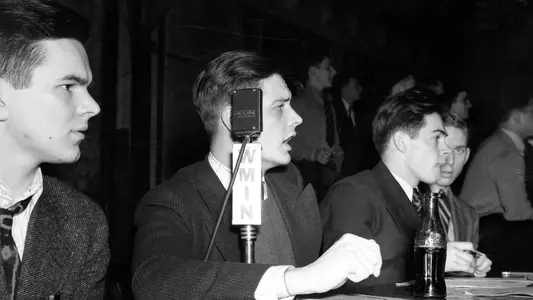
But for the roots of live coverage, you have to go back to 1938, when St. Paul-based radio station WMIN first started sponsoring live broadcasts of St. Thomas football and basketball games.
That partnership continued for more than a dozen years until WMIN made the first of several format changes.
Furniture retailer Edward Hoffman started WMIN Radio in the summer of 1936 and set up headquarters in downtown St. Paul. The station was at 1370 on the AM dial, and a few years later reassigned to 1400 AMThree Tommie football games in the 1938 season were carried live, including the St. Thomas-St. John's Homecoming game. Sig Davis, staff sports announcer for WMIN, handled the play-by-play. Other games broadcast that first season were against Hamline and St. Mary's.
Dick Enroth was another popular WMIN sports announcer in that era, and he called both Tommie and St. Thomas Academy games in later years.
The Aquin campus newspaper from the 1940s noted that WMIN carried all St. Thomas home basketball games and noted, "During the St. Olaf-St. Thomas basketball game, radio station WMIN aside from broadcasting the action took time out to give the All-College Council Sno-Shuffle dance some very worthwhile publicity."
One unique WMIN announcer who called a lot of Tommie games was Marty O'Neil. A St. Paul Central High graduate, O'Neil was a three-sport athlete and an accomplished amateur baseball player. He also officiated high school and college games before concentrating on broadcasting. He's probably the lone person to officiate a Tommie basketball game and serve as their radio play-by-play announcer.
The Aquin newspaper in 1950 wrote this account of a close call for O'Neill who arrived a little too close to tipoff for a sold-out basketball game between Augsburg and St. Thomas.
"Those cage fans who were turned away at the St. Thomas-Augsburg game last Saturday night, may be cheered up a bit when they find out that Marty O'Neill, WMIN sportscaster, was also a victim of the locked doors. Marty arrived at O'Shaughnessy Hall at 7:45 only to find the doors locked tight. After pounding on the gates proved to be unsuccessful, the astonished O'Neill was forced to climb a tree and rap on a window. This finally brought the attention of an attendant who permitted Marty entrance to the gym in order for him to announce his ball game."
O'Neill was eventually inducted into the Minnesota Broadcasting Hall of Fame, and not just because of his love of small-college sports... his work calling St. Paul Saints baseball games... or his resourcefulness of getting into locked gyms on game night. O'Neill became famous well beyond Minnesota as an announcer and interviewer for All-Star Wrestling telecasts in the 1960s and 1970s.
A tribute in O'Neill's Minnesota Hall of Fame bio reads:
In 1955 he began his career as a wrestling announcer. His knowledge of the sport, flawless delivery, and humility earned him the respect of everyone who worked with him.
WMIN changed call letters and formats several times between the 1950s and 1980s with different ownership and management. The station at times was known for country music, an all-news format, and even easy listening music, the latter when it promoted its "beautiful music" as station KLBB. There was even a span during the early 1950s when WMIN had a show with a "disc jockey" named Steve Cannon, who went on to an acclaimed radio career as a drive-time host on WCCO.
True to its call letters, WMIN had that 1938 Tommie-Johnnie football game to show its credibility with Minnesota sports.